Does Descript Train AI on Your Recordings?
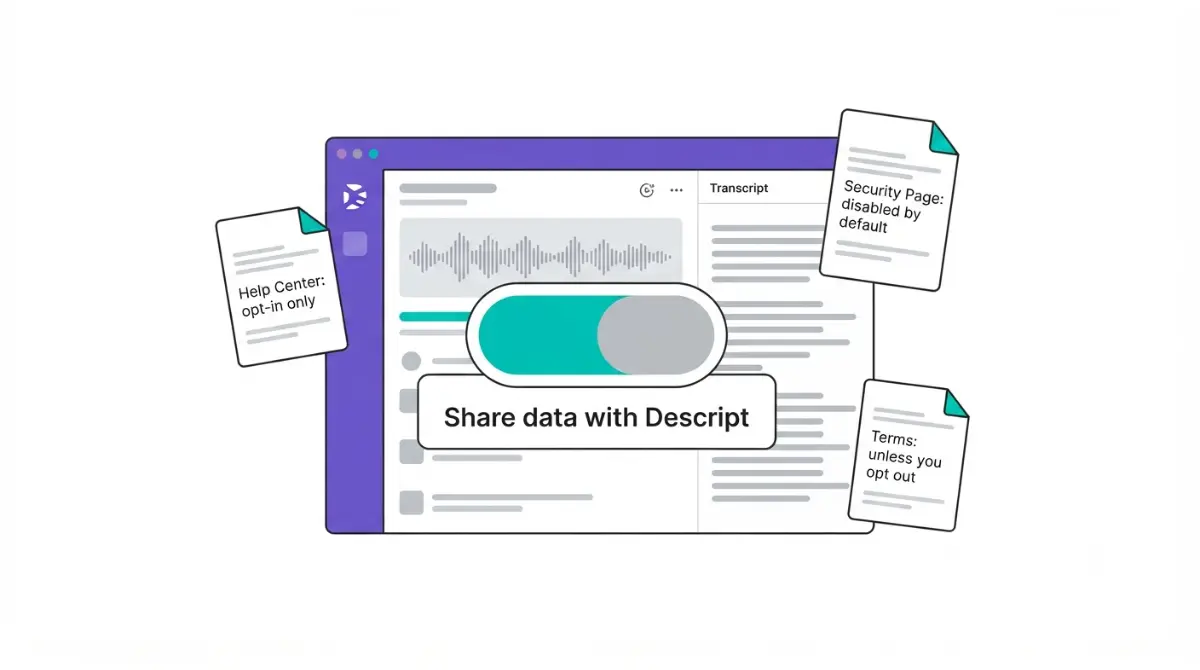
Table of Contents
Descript says it trains in-house models only on data from users with Share data with Descript switched on, and its production models use no customer data (Descript’s Help Center, retrieved 22 September 2026). Two catches: its own pages disagree on whether sharing starts on or off, and Custom Voice training audio can enter de-identified research datasets with no separate opt-out described.
What Descript says it does with your recordings
Descript’s pages split your data into streams, and each follows a different rule.
Production models vs research models
Per Descript’s Help Center article on account data and privacy, retrieved 22 September 2026, the AI models Descript runs in production use no Descript user data. Its internal research and development models use data only from users who opted into data sharing.
Descript adds that it has no plans to use opted-out users’ data at any stage.
What third-party AI providers can do
Some features run on sub-processors such as OpenAI. Descript’s Terms of Service (Last Updated 25 February 2025, retrieved 22 September 2026) say its agreements prohibit those providers from training their models on your inputs and outputs.
Is data sharing on or off by default?
Descript’s own pages disagree, and none states a clear default for a new individual account.
What each Descript page says
| Descript page | Last Updated | What it says about the default | Retrieved |
|---|---|---|---|
| Help Center | None shown | Users are prompted to set the preference during onboarding | 22 Sep 2026 |
| Security page | None shown | Sharing transcription information is disabled by default and only you can enable it | 22 Sep 2026 |
| Terms of Service §8.4(e) | 25 Feb 2025 | Descript may train its models on your inputs and outputs unless you have opted out | 22 Sep 2026 |
| Privacy Policy | 14 Apr 2025 | Lists research, including training AI models, as a use; says you can opt out of Projects being used | 22 Sep 2026 |
Why the wording matters
Opt-out wording in the Terms describes a setting you switch off. The Security page describes one that starts off.
We could not resolve from Descript’s published pages, retrieved 22 September 2026, which applies to a new account. The reliable check is your own setting, covered in the section on turning it off.
What happens to audio used for Custom Voice
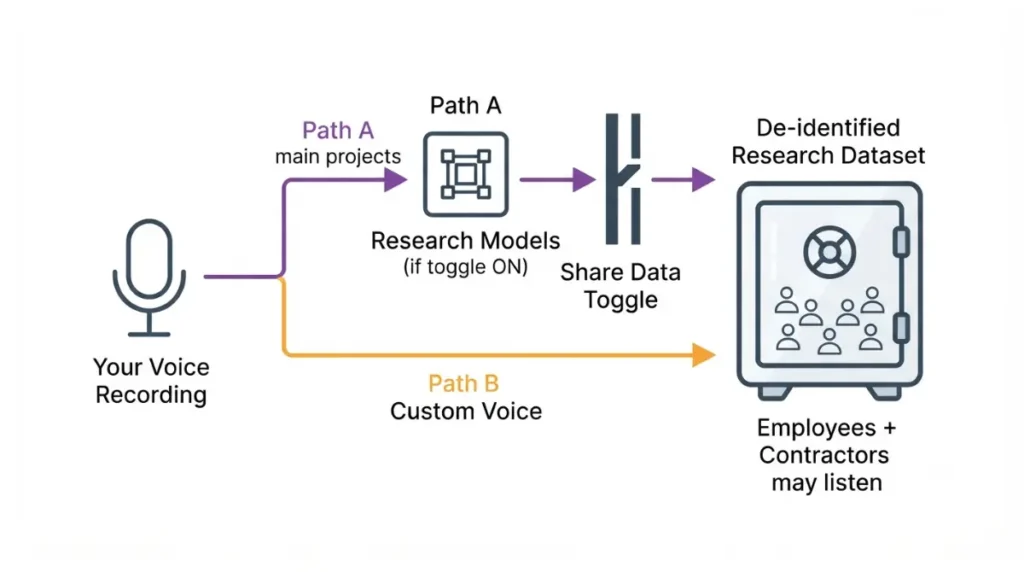
Voice cloning follows its own rules, and none of Descript’s pages retrieved 22 September 2026 says the data-sharing toggle covers it.
De-identified research datasets
Under the Terms of Service §9.3, training audio you submit for an AI voice can join Descript’s research datasets to train and improve its voice and other technology, after it is de-identified from your account.
The Privacy Policy (Last Updated 14 April 2025) says the same of AI Speakers data, which the Security page calls Custom Voice.
Who can listen to samples
Descript employees, vendors and contractors, including Amazon Mechanical Turk workers, may listen to samples of training and synthesized audio for quality checks and misuse monitoring (Terms §9.3).
Voiceprints made for identity checks are kept until their purpose is met or up to three years after you last accessed your account, whichever comes first, per the Privacy Policy.
✅ Do This: Descript’s Security page describes Custom Voice as optional. If you don’t want voice audio in research datasets, not creating a Custom Voice is the only documented way to avoid it.
How to turn off data sharing, and what it doesn’t undo
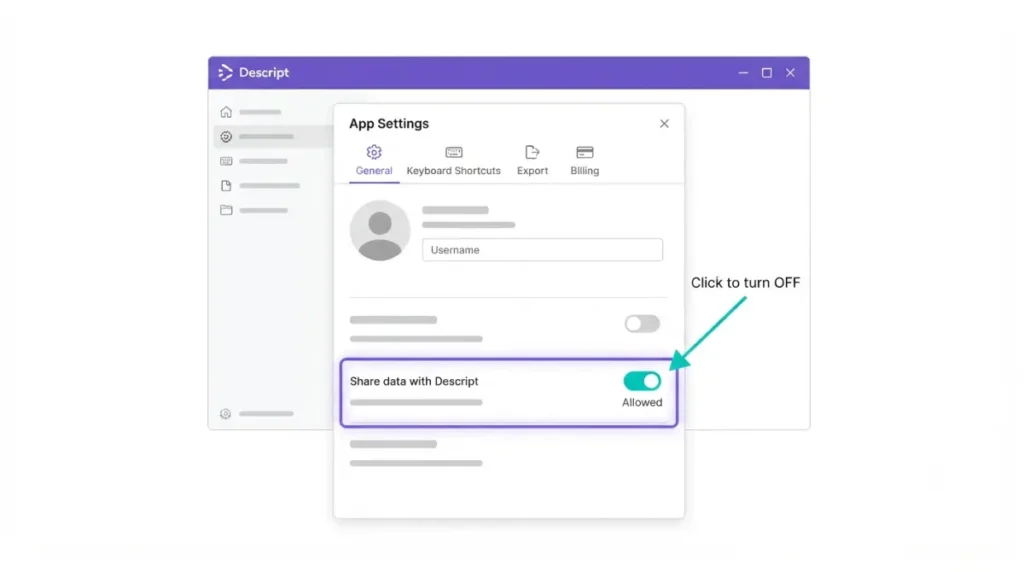
Descript’s Help Center, retrieved 22 September 2026, documents three steps:
- Open App Settings with Command/Control + , (comma).
- Select the Profile tab.
- Scroll to Share data with Descript and click Allowed to switch sharing off.
Enterprise accounts
Enterprise drives have no toggle; the Help Center says data sharing on them is disabled by default. If that matters to your team, compare what each Descript plan actually costs before choosing one.
Who owns your content
As between you and Descript, you own your inputs and outputs (Terms §8.4(a)). You also grant Descript a perpetual, irrevocable licence to use your content to provide, maintain and improve the service, subject to the Terms’ confidentiality section (§8.2).
Deleting a project
The Security page says deleted projects are removed from Descript’s servers within 30 days. It also says deleting your account removes the associated data.
Neither document explains how that fits the perpetual licence. No page we retrieved says whether switching sharing off removes data already used in research. If you’re leaving, export your transcripts before you cancel.
How Descript can change these rules
Descript’s Terms of Service, retrieved 22 September 2026, say amended terms take effect immediately unless the notice says otherwise, and continued use counts as acceptance.
How policy changes take effect
The Terms say notice may come by email, through the app, or by updating the date at the top of the Terms.
The dates to check
The Terms show 25 February 2025 and the Privacy Policy 14 April 2025. The Help Center article and Security page show no update date.
When the toggle isn’t enough
If you record clients, interviewees or guests, the toggle covers your projects but leaves some questions open.
Client and guest recordings
A setting can change; a written answer is a record. Descript’s Security page, retrieved 22 September 2026, names a Data Protection Officer at dpo@descript.com for questions about how your data is handled.
Using your privacy rights
The same page lists rights to access, portability, correction, objection and withdrawing consent, with requests sent to that address. EU, UK, Swiss and some US-state residents have added rights set out in Descript’s Privacy Policy, which also links to national data protection authorities.
Before you commit to the app at all, see whether the Descript download is safe. This isn’t legal advice; for client or regulated recordings, confirm your obligations with a qualified adviser.
🧾 Not Tested: We did not create a Descript account for this article. That means we could not see which state Share data with Descript starts in for a new user, or whether the setting covers Custom Voice audio. Everything above comes from Descript’s published pages, retrieved 22 September 2026.
Frequently asked questions
1. Does Descript train AI on my recordings?
Descript’s production models use no user data; its research models use data only from users who opted into data sharing, per its Help Center, 22 September 2026.
2. Is Descript data sharing on by default?
Descript’s pages disagree: its Security page says sharing is disabled by default, while its Terms describe training unless you opt out.
3. How do I turn off data sharing in Descript?
Open App Settings, select the Profile tab, then click Allowed under Share data with Descript to switch data sharing off.
4. Does Descript use voice clone audio for training?
Descript’s Terms allow Custom Voice training audio into de-identified research datasets. No Descript page we retrieved says the data-sharing toggle covers this.
5. Does OpenAI train on my Descript data?
No, per Descript: its agreements prohibit third-party AI providers, including sub-processors like OpenAI, from training their models on your inputs and outputs.
6. Is data sharing off on Descript Enterprise?
Yes. Descript’s Help Center says Enterprise drives have data sharing disabled by default, with no toggle to change it.
7. Who owns content I make in Descript?
You own your inputs and outputs under Descript’s Terms, but you grant Descript a perpetual licence to use them to run and improve the service.
8. Does deleting a Descript project remove it?
Descript’s Security page says deleted projects are permanently removed from Descript’s servers within 30 days of deletion.
9. Can Descript employees hear my recordings?
For Custom Voice, Descript’s Terms let employees, vendors and contractors, including Mechanical Turk workers, hear audio samples for quality and misuse checks.
Where this leaves you
On Descript’s published pages, retrieved 22 September 2026, your projects train in-house research models only if data sharing is on, and production models use none. Descript’s own documents dispute the default, so check the Share data with Descript setting yourself. Voice-clone audio follows separate rules, with no documented off-switch.